DMA
With polling or interrupts, the CPU still performs the actual data movement (load/store per byte/word). For large transfers, that is slow and ties up the CPU.
DMA (Direct Memory Access) adds a hardware controller that copies data between memory and devices (or memory-to-memory) with minimal CPU involvement:
- CPU programs source, destination, length, and starts DMA
- DMA becomes a bus master and performs bulk transfers
- DMA signals completion via status or interrupt
DMA engine register map (Logisim)
Section titled “DMA engine register map (Logisim)”| Offset | Register | Access | Description |
|---|---|---|---|
| 0x00 | SRC_ADDR | R/W | source address (word-aligned) |
| 0x04 | DST_ADDR | R/W | destination address (word-aligned) |
| 0x08 | LENGTH | R/W | length in bytes (multiple of 4) |
| 0x0C | CONTROL | R/W | control bits |
| 0x10 | STATUS | R/W1C | status bits |
| 0x14 | BYTES_DONE | R | bytes transferred so far |
Table 9.6: DMA engine MMIO registers (relative to base).
| Bits | Name | Attr | Meaning |
|---|---|---|---|
| [0] | START | W | write 1 to start (ignored if BUSY=1 or LENGTH=0) |
| [1] | IRQ_EN | R/W | enable interrupt on completion |
Table 9.7: DMA CONTROL fields.
| Bits | Name | Attr | Meaning |
|---|---|---|---|
| [0] | BUSY | R | 1 while transfer in progress |
| [1] | DONE | R/W1C | set on completion; write 1 to clear |
Table 9.8: DMA STATUS fields.
Experiment: DMA transfer to VGA (polling)
Section titled “Experiment: DMA transfer to VGA (polling)”Objectives
Section titled “Objectives”- Program the DMA engine (src/dst/length/start/status polling).
- Compare CPU copy vs DMA copy for a large buffer.
Environment
Section titled “Environment”- Simulator: Logisim Evolution
- Toolchain:
riscv64-unknown-elf-gcc
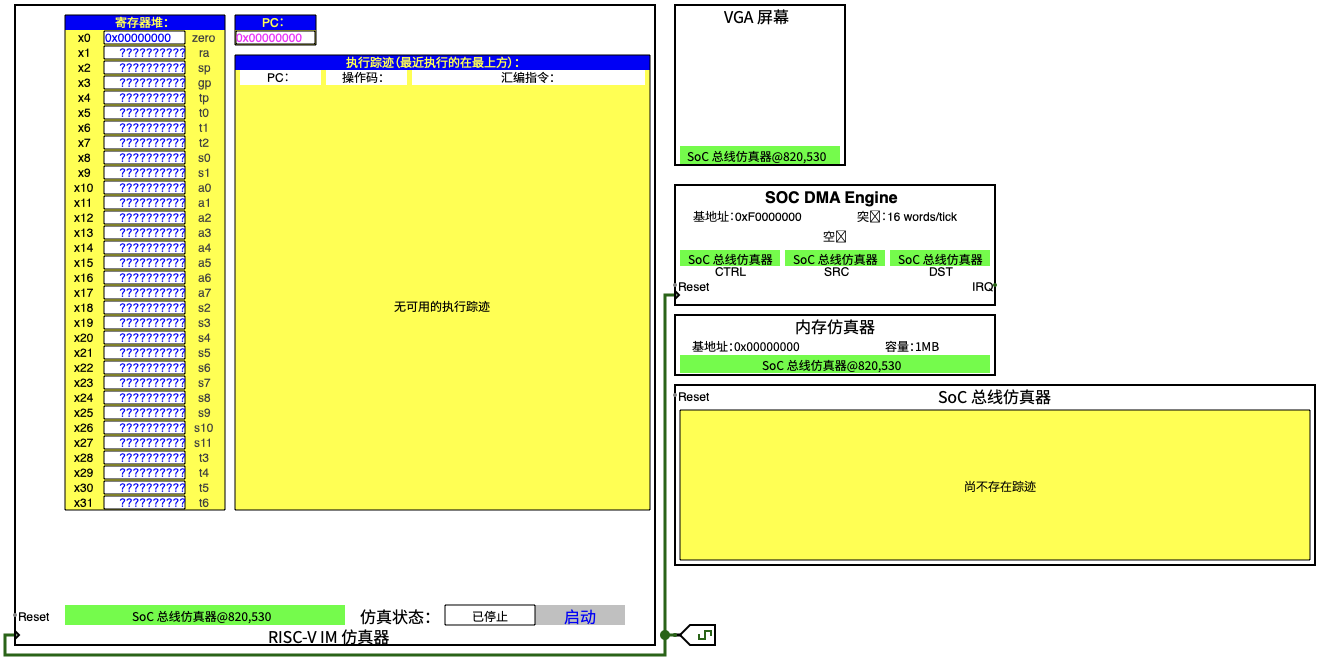
Figure 9.3: DMA + VGA SoC wiring.
Task: Complete a polling DMA copy function
Section titled “Task: Complete a polling DMA copy function”Fill in the TODO in copy_pixels_dma:
#include "utils.h"
void copy_pixels_cpu(uint32_t *dst, uint32_t *src, uint32_t pixels) {  for (uint32_t i = 0; i < pixels; i++) {    *dst++ = *src++;  }}
void copy_pixels_dma(uint32_t *dst, uint32_t *src, uint32_t pixels) {  /* TODO: program DMA registers, start transfer, poll BUSY until done.   *   1) write src to DMA_SRC_ADDR   *   2) write dst to DMA_DST_ADDR   *   3) write byte length to DMA_LENGTH (bytes = pixels * 4)   *   4) write START to DMA_CONTROL (IRQ_EN = 0)   *   5) poll DMA_STATUS BUSY until it becomes 0   */}
Code 9.5: DMA copy task skeleton (vga_dma_task.c).
Results
Section titled “Results”- Completed source.
- Screenshot of VGA scrolling output.
- Measure cycles for one CPU scroll vs one (or eight) DMA scrolls; compute speedup.
Questions
Section titled “Questions”- Why is DMA much faster than CPU copy (instruction overhead vs burst hardware transfers)?
- What is the CPU doing while polling BUSY, and how could you overlap useful work or use an interrupt?
- Can CPU and DMA safely access the same memory region at the same time? Why/why not?